The rules
STRA register NSW: the short-term rental rules, night caps and fire safety
Every short stay in NSW, hosted or not, runs under one state framework: a register, a fire safety standard, a code of conduct and, in some areas, a cap on nights. Here is each part, from the government's own pages.
By the Temporary Rentals NSW editorUpdated 16 October 20268 min read
Numbers checked 29 Sep 2026 · AirROI estimates and NSW Government rents
The short answer
Register the home on the NSW STRA Register before you advertise ($65, then $25 a year), meet the fire safety standard, follow the code of conduct, and if you do not live there, stay within any night cap: 180 a year in Greater Sydney, Ballina and parts of Clarence Valley and Muswellbrook; 60 in most of Byron Shire. Bookings of 21 nights or more do not count.
1. The STRA Register
Every short-term rental in NSW must be registered on the government's register, through the NSW Planning Portal, before you advertise it. Registration costs $65 for the first 12 months and $25 a year to renew. You declare that the home meets the fire safety standard; no certificate is needed, and your council checks compliance. Caravans, tents and moveable dwellings do not need registering.
2. Night caps (non-hosted stays only)
Hosted stays, where you live in the home while guests stay, can run 365 nights a year. Non-hosted stays are capped in some areas under the exempt development pathway:
| Area | Non-hosted nights a year |
|---|---|
| Greater Sydney (Eastern Harbour City, Central River City, Western Parkland City; not the Central Coast) | 180 |
| Ballina | 180 |
| Certain land in Clarence Valley and Muswellbrook | 180 |
| Byron Shire, outside two mapped precincts (from 23 September 2024) | 60 |
| Byron Bay town centre and Brunswick Heads precincts | 365 |
| Everywhere else in NSW, including Newcastle and the Hunter | 365 |
The count runs over 12 months from the date you registered, and bookings of 21 nights or more in a row do not count. Booking platforms share booking information with the register.
Counting nights under a cap: a worked example
Take a non-hosted apartment in Greater Sydney, with a 180-night cap, registered on 1 March. Over the next 12 months it takes:
| Bookings | Nights | Count toward the cap? |
|---|---|---|
| Weekend and weekday stays through the year | 150 | Yes |
| One five-week stay by a visiting academic | 35 | No: a booking of 21 nights or more in a row is exempt |
| A two-week summer holiday booking | 14 | Yes |
The apartment is let for 199 nights, but only 164 count, so it stays under 180. Without the five-week booking it would have needed to stop at 180 counted nights before the next 1 March. In Newcastle and the rest of the Hunter, outside the capped areas, there is no limit to count.
3. Fire safety
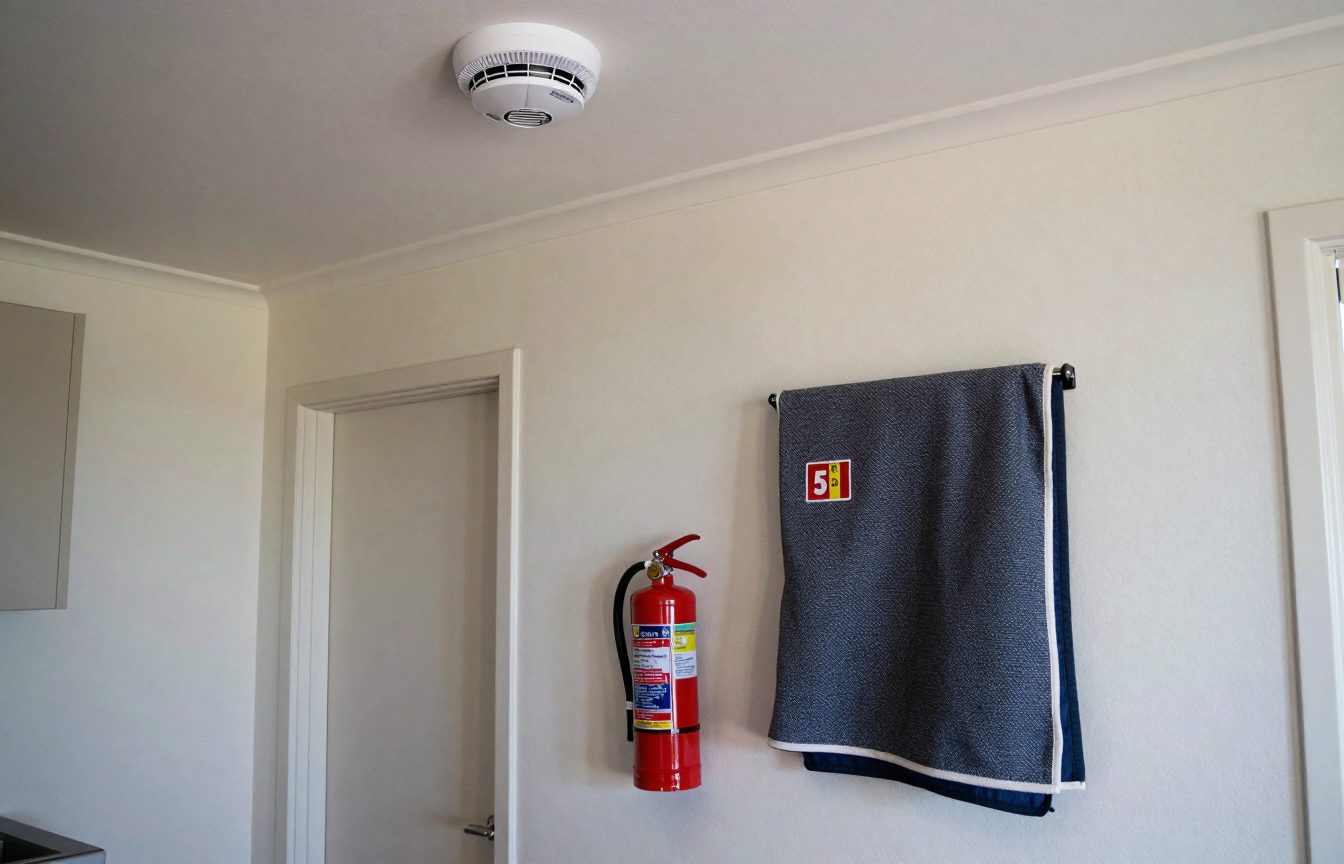
For a house or townhouse: interconnected smoke alarms in the hallway near bedrooms and on every storey, a heat alarm in an attached garage where required, an evacuation diagram at the entrance and in every bedroom, and for apartments also a 2.5 kg ABE fire extinguisher and a fire blanket in the kitchen. Smoke alarms must be mains powered or have a 10-year non-removable battery.
4. The code of conduct
A mandatory code applies to hosts, guests, letting agents and booking platforms. Breaches can lead to a listing on the exclusion register. Noise, fire safety, parking and planning complaints still go to your council; urgent noise goes to police.
5. Strata
Owners corporations can adopt by-laws restricting short-term rentals, but only in lots that are not the host's principal place of residence.
The code of conduct, in more detail
The code of conduct is mandatory for everyone in the short-term rental industry: hosts, guests, letting agents, facilitators and booking platforms. It sets standards for how hosts and guests behave, how bookings and complaints are handled, and what platforms must do. Two parts matter most for a new host.
Insurance. The NSW Government says the code requires hosts to hold insurance that covers liability for third-party injuries and death. A platform's guarantee or host protection program is not the same thing, so check what your own policy covers before your first guest arrives; our Airbnb insurance guide explains the gaps.
Strikes and exclusion. The Commissioner for Fair Trading can issue a strike against a host or guest for deliberate and persistent breaches of the code, and those who accumulate strikes can be placed on an exclusion register, which stops them hosting or booking through the industry for a period.
Complaints: who handles what
| Problem | Where it goes |
|---|---|
| A breach of the code of conduct by a host, guest, agent or platform | NSW Fair Trading, as a short-term rental accommodation complaint |
| A dispute about a cancellation, fees or charges | NSW Fair Trading, as a product or services complaint |
| Unregistered premises, fire safety, or the night cap | Your council |
| Damage, ongoing noise, parking or use of common property in a strata building | The owners corporation or strata manager |
| Criminal activity or urgent noise | The police |
Hosts, guests, neighbours and owners corporations can all complain to NSW Fair Trading about a breach of the code.
Strata buildings, in more detail
Owners corporations can make by-laws restricting short-term rentals, but only in lots that are not the host's principal place of residence. So a strata scheme can stop an owner who lives elsewhere from letting a whole unit as a short stay, but cannot stop an owner who lives in the unit from letting a room. Owners corporations can also set an occupancy limit of two adults per bedroom by by-law. Before you buy a unit to let, or sign a lease intending to sublet one, read the current by-laws and the minutes of recent meetings for any proposal to change them.
Registering, step by step
The register is run through the NSW Planning Portal. NSW Planning sets out what registration involves:
- Create a Planning Portal account if you do not have one.
- Enter the property and host details. These are not made public.
- Confirm the dwelling meets the fire safety standard and agree to follow the code of conduct. You declare this yourself; no certificate is lodged.
- Pay the $65 fee. Registration and renewal fees are non-refundable.
- Use the registration when you list: booking platforms can connect to the register to send booking information, which is how night caps are counted.
| Event | What happens |
|---|---|
| Renewal | Due every year from the original registration date, $25; it opens 45 days before expiry, with reminders at 45, 30 and 7 days |
| A registration lapses | It is held for three more months and blocked from online booking platforms |
| Still not renewed after that | It is de-registered and cannot be renewed; a new registration is needed |
| You sell the property | The previous owner de-registers, and the new owner creates a new property ID; future bookings linked to the property must be cancelled first |
A lapsed registration is the easy mistake: the listing stops taking bookings through the platforms, and leaving it too long means starting again.
Hosted or non-hosted: the definition that decides the cap
NSW Planning defines a hosted stay as one where the host lives on the premises while guests stay. The owner must live on the property, but not necessarily in the part that is rented, so a homeowner can let a granny flat in the back yard all year. A non-hosted stay is one where the host does not live there. Individual apartments with an onsite manager or concierge are generally treated as non-hosted, because the manager is not the host living in the home.
That distinction is what the night caps hang on. In most of the Hunter there is no cap either way, but in Greater Sydney a whole apartment let while you live elsewhere counts against the 180 nights, while a spare room in the home you live in does not.
What does not count as short-term rental accommodation
Some kinds of dwelling cannot use the short-term rental pathway at all, and some kinds of accommodation do not need to register:
- Not permitted under the exempt pathway: boarding houses, seniors housing, rural workers' dwellings, group homes, hostels, refuge or crisis accommodation, build-to-rent housing, co-living housing and moveable dwellings.
- Does not need to register: approved tourist and visitor accommodation such as serviced apartments, bed and breakfasts, hotels, motels, camping grounds and caravan parks, and agritourism including farm stays.
A development consent condition on your property, or your strata by-laws, can still restrict short stays even where the state rules would allow them. Check both before you list.
What councils do
Every council can see the register and enforce the planning rules. NSW Planning says councils handle inquiries and compliance concerns, including unregistered premises and fire safety problems such as missing smoke alarms; can monitor the register for night-cap breaches and start investigations that may lead to penalties; and can confirm the type of dwelling and any development consent conditions. Ongoing neighbourhood noise complaints go to the council or the police. Not complying with the fire safety standard carries penalty notice offences.
The review of the rules
The NSW Government is reviewing the short-term rental framework. Its discussion paper was on exhibition from 15 February to 14 March 2024 and drew more than 430 submissions and over 2,400 survey responses. When NSW Planning last updated its page, on 10 February 2025, it said no policy changes had been announced. Byron Shire's 60-night cap, from 23 September 2024, was made separately. Check the NSW Planning page before you rely on the current rules, especially if you are buying a property to let.
Before your first booking: a checklist
- Check the night cap for your council area, and whether your stay is hosted or non-hosted.
- Check your strata by-laws and any development consent conditions.
- Fit the smoke alarms, evacuation diagrams and, for an apartment, the extinguisher and fire blanket the fire safety standard requires.
- Register on the Planning Portal and keep the confirmation.
- Read the code of conduct, which binds you, your guests and any letting agent.
- Put the renewal date in your calendar, 45 days before the anniversary.
- If you rent the home yourself, get the landlord's written consent first: our guide to whether Airbnb arbitrage is legal explains why.
Common questions
Do I need to register my Airbnb in NSW?
Yes. Register it on the NSW STRA Register through the Planning Portal before you advertise: $65, then $25 a year.
Is there a 180-day limit on Airbnb in NSW?
For non-hosted stays in Greater Sydney, Ballina and parts of Clarence Valley and Muswellbrook, yes. Most of Byron Shire is 60 days. Elsewhere there is no cap.
Do long bookings count towards the cap?
No. Bookings of 21 consecutive days or more are exempt from the day limits.
How much does it cost to register a short-term rental in NSW?
$65 to register on the STRA register, then $25 a year to renew. Both fees are non-refundable.
What happens if my STRA registration lapses?
It is held for three months and blocked from online booking platforms. If it is still not renewed, it is de-registered and you have to register again.
Is a granny flat a hosted stay?
Yes, if the owner lives on the property while guests stay, even if not in the rented part. Hosted stays have no night cap.
Do I need to register a caravan or a farm stay?
No. Moveable dwellings cannot use the short-term rental pathway, and approved tourist accommodation and agritourism, including farm stays, do not register on the STRA register.
Does the 180-night cap apply in Newcastle?
No. Newcastle and the rest of the Hunter are outside the capped areas, so non-hosted short stays can run all year, subject to strata by-laws and any development consent conditions.
Sources
- NSW Planning, Short-term rental accommodation (register, fees, day limits, fire safety)
- NSW Planning, Byron Shire (60-day cap from 23 September 2024; two 365-day precincts)
- NSW Planning, STRA framework FAQ (hosted stays unlimited; Greater Sydney excludes the Central Coast)
- NSW Planning, Short-term Rental Accommodation Fire Safety Standard
- NSW Planning Portal, STRA register
- NSW Government, Short-term rental accommodation (code of conduct, insurance, strikes, complaints, strata by-laws and occupancy limit)
- NSW Planning, Short-term rental accommodation (registration, renewal, lapsed registrations, hosted and non-hosted, exclusions, councils, the framework review), last updated 10 February 2025
This is general information, not financial or tax advice. These are estimates from market data; your own place could earn more or less.